Daddy pickup (Or, how the pandemic changed parenting, and what we lose if it changes back)
Dads are more hands on than ever. Those gains will change society, if we defend them.

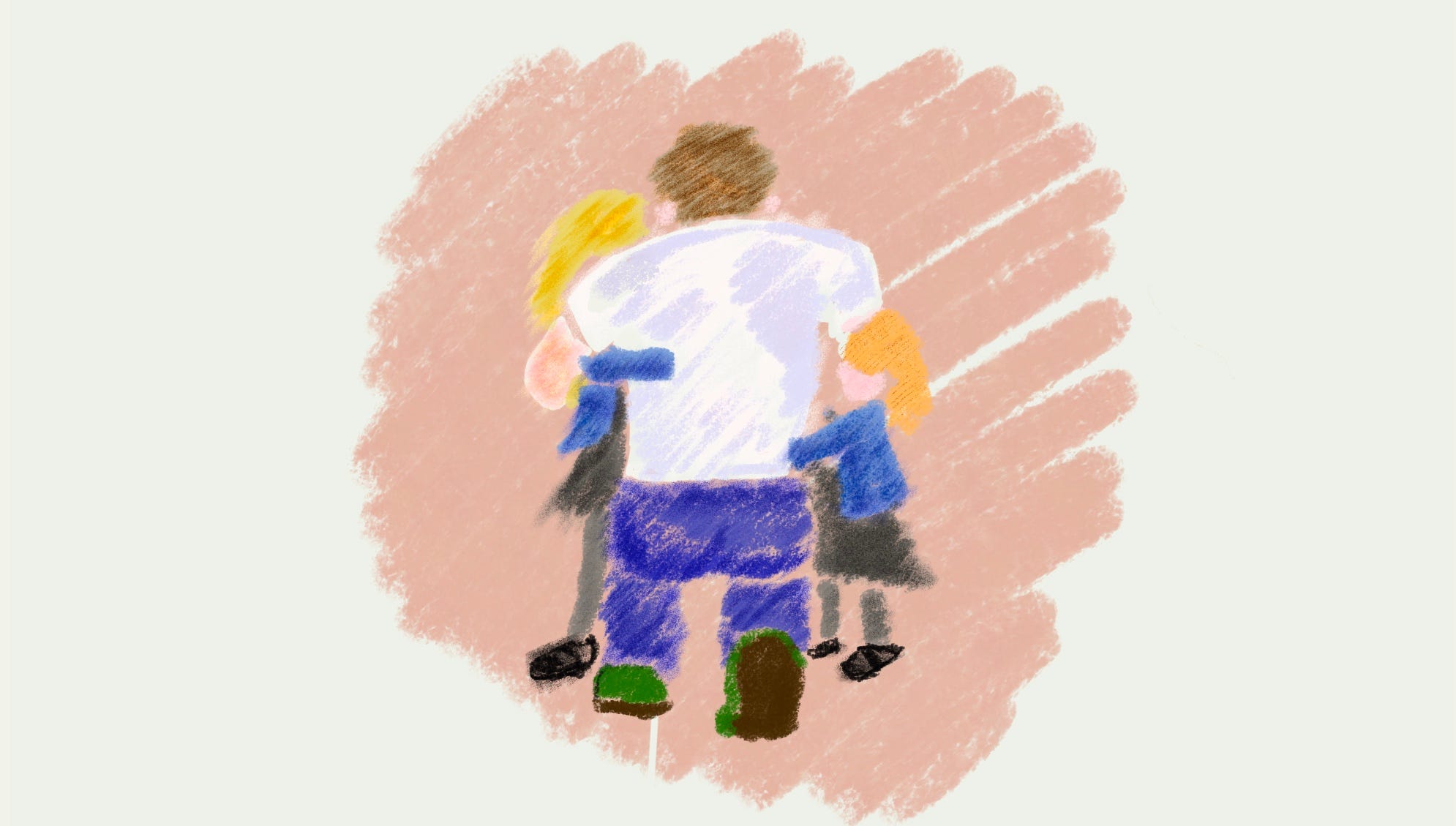
Today, instead of writing about writing, I want to talk about what happens after: most days, I put my laptop away, put the dog on her lead, and walk out in the cold air to my little girls’ school, where I wait with the other parents chatting at the gate.
I don’t remember my dad ever picking me up from school. Not at kindergarten, not at any of the several primary schools I attended while we were moving around the country for his work, and not when I was older, at grammar school a train ride away. It was the ‘90s, and he worked in finance; even then, where I grew up, it was a given that the school run was for mums. Basketball practice after home time? Mum did pickup. A rugby game on a Saturday? Most often it was mum on the sidelines, while the dads recharged from their stressful week in the office by playing golf, or tennis, or used those things as excuses to cover up an affair. Parenting back then was something that women did.
When my wife and I first got pregnant, nine years ago now (jesus, where did that go) I knew that I wanted to be the one who stayed home. She has a job that she loves, is better paid, more secure, and — crucially — can’t be done remotely in the way that writing can. Plus, I wanted to be a dad: to be there for my kids in the way my dad had never been for me. So shortly after my eldest was born I took a redundancy payout and spent the first four years of her life juggling freelancing, writing a book, and most of all, being with her: taking her to baby classes, to vaccination appointments, on days out to the farm, or just down to the swings. I was there the day she learned to walk; I was there for her first day of school. I was there.
This was years ago now, but I remember being astonished then by the way that, on Monday mornings, the men just seemed to disappear. Out here in the suburbs, weekdays were populated by the elderly, and mums with prams. I got used to being the only dad in baby classes; the only dad on the playground, the only dad at coffee morning.
(I should say, before we go further: my wife is a miraculous parent, and still did — and does! — way more than her share while also kicking ass at work, enabling me to travel, and covering me when I got sick. This isn’t about her at all.)
When my eldest daughter eventually started school, I would guess that the number of dads doing pickup barely scratched 10 percent. (Shout out to the old timers on the grandparent shift, though.) Then the pandemic happened, and suddenly men who had been both contractually and culturally expected to be in the office were at home. Overnight, guys in the Millennial Dad uniform of BabyBjorn, overshirt and beanie appeared on the playground and at the birthday parties. And sure enough: at the school gate, there, finally, were the dads, dropping their kids off, and picking them up at the end of the day.
We now know that the pandemic prompted the biggest change in fatherhood in generations. By the time the lockdowns were over, millennial dads were found to be doing 2.5 hours more childcare per week than pre-covid. ‘Sandwich generation’ millennials (those also caring for older parents), are now doing an average of seven hours’ more childcare per week. In the UK, the amount of time dads are spending with their kids has risen by a fifth since 2015, while the number of stay at home dads has risen by a third.
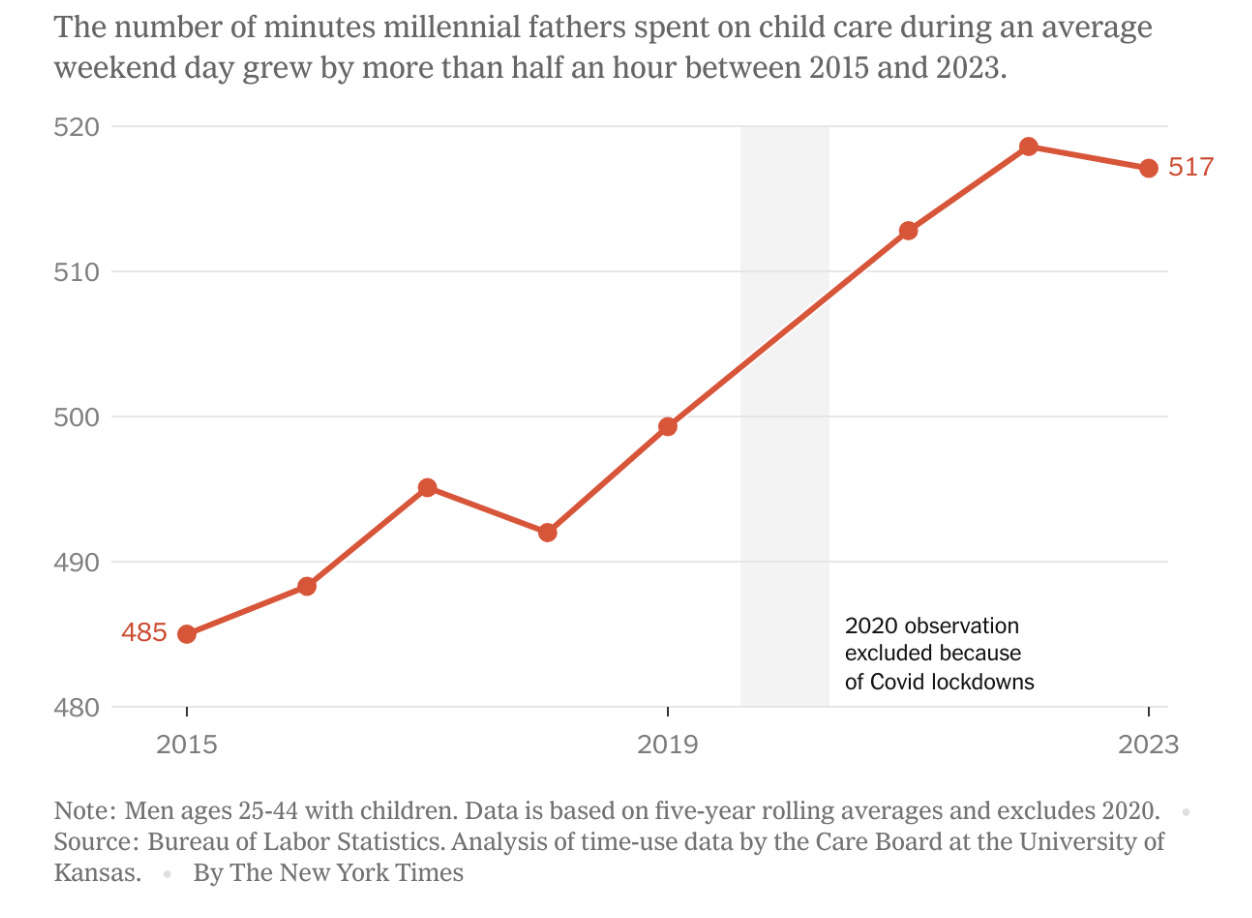
Two sociologists at the University of Surrey, Paul Hodkinson and Rachel Brooks, have conducted research on how the pandemic changed British parenting. More often than not, they found, the lockdowns forced fathers to be much more hands on. Moreover, they wrote, “we found the men’s care roles had proved highly durable” — that is, even after the pandemic, they didn’t go back to the old way of doing things. Instead, their new roles “had become routine, expected, and enduring.” The side effects of this are manifold, but I was particularly taken with one: of the men studied, an astonishing 65% of fathers with partners reported they had an improved relationship with their child.
I’ve thought about that a lot this year, watching the discourse play out around shows like Adolescence, and reading so much about the toxic situation right now for young men and boys. In many ways, it’s a scary time to be a young man. (And a young woman, but no change there.) But perhaps naively, it’s given me hope, knowing that the teenagers now struggling to make sense of the world — their heads scrambled by Tiktok and the manosphere and the crushing isolation of a screen-based childhood — are also likely to be the last generation to grow up in a society where dads were, empirically, far less present.
I’m not saying that having dads around more will fix things necessarily, only that it will inevitably change things. It is changing, for example, the financial dynamics of many couples, with more men choosing to prioritise parenting, so that their partner can stay in full-time work.1 Relatedly, it is likely to change the shape of the workforce. It will likely have a positive effect on educational outcomes, as studies show that hands-on fathers improve how kids do at school, whatever their age, race, or gender.
Don’t get it twisted: mums are still far more likely to be ones stepping back from their careers: 37% of women in the UK work part-time, compared with 11% of men.2 And mothers are still doing, on average, far, far more childcare than men are — 53% more, according to ONS data. But that is down from 86% ten years ago.
I worry that, as the economy moves away from flexible and remote working, that workplace trends are going to undo these gains of the last few years. In the US, more men are returning to the office than women. There isn’t much data to say if the same is true here, but I would say that anecdotally, many of the dads I know are having to go back to work, less flexibly than their partners. (This in the UK is at least partly rooted in the so-called “childcare disparity” — which still holds that women are the primary caregivers, and is one reason why women are three times more likely to work flexibly, and men are more likely to have flexible working requests denied.)
Doing pickup is the highlight of my day. The yells of “daddy!” The bears hug around the knees. Carrying my youngest while she tells me proudly about the sticker she earned that day, or the new phonics song they learned in class; my eldest regaling me with a new fact about the ancient Egyptians, or providing a play-by-play of the latest internecine playground drama. I love helping them with piano practice, and with their reading books – and that maybe that's why they both love to read, in a world where children’s literacy is in free fall. I even don’t mind the bickering at bed time.
I don’t know that my kids will be better off than I was for having a dad around. I hope so, though I’m always mindful of Philip Larkin.
What I do know is that I am better off for being there for them. And that when I drop them off at the door in the morning, a little part of me leaves with them — until it comes running out of the gate again, arms wide, at the end of the day.
Although in the UK, women are still far, far more likely to be in part-time work due to childcare needs.
And the growth in this figure is being somewhat distorted by the rise of zero-hours and precarious work.
This was a great read, Oliver.
I feel very fortunate to have been around so much during our kids’ early years (they’re 5 and 8) and to be in a position where we can split the school runs.
That just wouldn’t have been the case pre-pandemic with the expectation to be out the house from 8-6 every day, only seeing them for an hour or so when everyone is knackered etc. It’s made such a difference!